Background on 35th Ave NE Neighborhood Planning
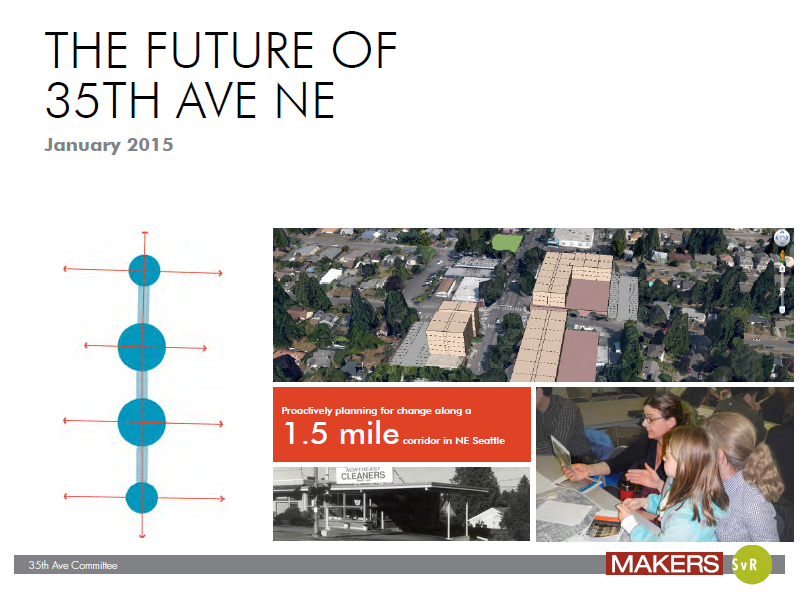
In 2012, residents of Wedgwood, Ravenna, and Bryant neighbors kicked-off what would ultimately culminate in the Future of 35th Ave NE plan. This was a unique community-led plan created to pursue a pro-active plan for a neighborhood business district that had remained largely untouched since it was incorporated into the city and zoned in 1947 and then again in 1973.The process we set out to pursue was intended to maximize community involvement and engagement in the hopes of identifying a shared vision for the 35th Ave NE corridor. There was no prior 'hidden agenda' with our plan. We simply wanted to accomplish two goals:
- Educate our neighbors about the 35th Ave NE corridor and
- Listen and learn about what they wanted for out 35th Ave NE corridor in the future.
Our Neighborhood District is "Exceptional"
Ordinarily, a 'neighborhood plan,' as recognized by the city, is initiated by the city in areas designated Urban Villages. Following the city's formal neighborhood planning process, the plan is adopted by the city council with legislation to amend the comprehensive plan, zoning plan, and other relevant plans and codes for consistency.But, this was not a formal neighborhood plan within an Urban Village. Nevertheless, we pursued a plan that would ultimately be a non-binding guidance document which we would have to be advocates for. Over time, the city came to support our planning efforts and awarded us a $25,000 neighborhood matching fund grant through the city's Department of Neighborhoods to contract with a planning firm to formalize the plan, which we are enormously grateful for.
The Upside of Being Exceptional
Between 2012 and 2015, we were able to engage and listen to literally thousands of community members. Ultimately, our Future of 35th Ave NE plan was endorsed by both the Wedgwood Community Council and the Ravenna-Bryant Community Association. The Future 35th Ave NE plan describes a shared vision for 35th Ave NE corridor and features recommended zoning changes, streetscape guidelines, and supplemental design guidelines for the corridor to provide the density and walkability desired to support the business district desired by the community.The Downside of Being Exceptional
As noted before, due to city policies our plan could not follow city-led 'neighborhood planning' process with a clear outcome. Therefore, to implement our plan, we pursued three different strategies for the rezoning recommendations, streetscape guidelines, and our supplemental design guidelines.- First, for the rezone recommendations, our strategy was to advocate to the city council to fund the Department of Planning and Development (now the Department of Planning & Community Development) to analyze our rezone recommendations and conduct a legislative rezone. We were successful on this front and the city council included our request in DPD's budget. While our recommendations were not adopted entirely, there is much to be euphoric about on this as described below.
- Next, for the streetscape guidelines, we hoped to present our streetscape guidelines to SDOT for inclusion in their Right-of-Way Improvements Manual (ROWIM), which is the document that guides (as the title of the document implies) future improvements within to the right-of-way. Unfortunately, we were not successful at this. More on this below.
- Finally, we developed supplemental design guidelines to give developers early guidance for future development along 35th Ave NE. These guidelines are intended to promote excellent design of future developments within the business district to further a safe and walkable community with architectural design elements that soften the impact of adjacent single-family residential properties. For those neighborhood plans that approved by the city, design guidelines are adopted by the city and developers must demonstrate how they have considered the design guidelines to the design review board. In order to help developers learn about our supplemental design guidelines early in the design process, we sent a copy of them to the city's planners in February 2015 with the hopes that the planners would make developers aware of our Future 35th Ave NE plan and supplemental design guidelines during a developer's initial contact with the city. However, educating developers of these supplemental design guidelines is an on-going process.
Zoning Recommendations Update
In July 2015, following their analysis of our proposed zoning changes, DPD presented their recommendations to rezone the corridor to the community which was significantly scaled back from what was included in our plan. While initially disappointed at the time, we were at least pleased that the city had formally considered the needs of our neighborhoods and business district and pursued legislation to codify the zoning changes. Unfortunately, the city halted our legislative rezone request when they began considering the Mandatory Housing Affordability (MHA) policy.
MHA, a form of inclusionary zoning, places an affordable housing requirement on all new residential development (not single-family). To offset this affordability requirement and comply with both state law and avoid a violation of the 'takings' clause under the state and U.S. Constitution, MHA includes an upzone of those parcels which are subject to this affordable housing mandate. Therefore, adopting DPD's legislative rezone requirement for 35th Ave NE would have limited the city's ability to require affordable housing in our community under MHA.
Along with their unanimous approval of MHA on March 19, 2019, the city council also approved a citywide rezone (again, leaving single-family parcels untouched), which includes our 35th Ave NE business district. We were very pleased - maybe even euphoric! - to see that our recommendations within the Future 35th Ave NE plan were significantly closer to those zoning recommendations included within our plan than DPD's scaled-back proposal was. Our community's zoning plan lives on!
MHA, a form of inclusionary zoning, places an affordable housing requirement on all new residential development (not single-family). To offset this affordability requirement and comply with both state law and avoid a violation of the 'takings' clause under the state and U.S. Constitution, MHA includes an upzone of those parcels which are subject to this affordable housing mandate. Therefore, adopting DPD's legislative rezone requirement for 35th Ave NE would have limited the city's ability to require affordable housing in our community under MHA.
Along with their unanimous approval of MHA on March 19, 2019, the city council also approved a citywide rezone (again, leaving single-family parcels untouched), which includes our 35th Ave NE business district. We were very pleased - maybe even euphoric! - to see that our recommendations within the Future 35th Ave NE plan were significantly closer to those zoning recommendations included within our plan than DPD's scaled-back proposal was. Our community's zoning plan lives on!
Streetscape Guidelines Update
As noted above, our plan included streetscape guidelines to improve the pedestrian experience and safety along the 35th Ave NE corridor. However, from the outset of our planning, we were explicit that our plan would not discuss the parking or travel lanes given that the Seattle Department of Transportation (SDOT) had identified 35th Ave NE as a planned corridor for a protected bike facility in its Bike Master Plan.
Knowing that such a project would be contentious and believing the city would need to complete their own outreach and engagement process and undertake significantly more design and engineering than our $25,000 Neighborhood Matching Fund grant could allow, we intentionally avoided everything from curb-to-curb. We only focused on the pedestrian environment. Unfortunately, when we took our streetscape guidelines to SDOT for inclusion within their ROWIM, we were told that (clarification from the author):
Knowing that such a project would be contentious and believing the city would need to complete their own outreach and engagement process and undertake significantly more design and engineering than our $25,000 Neighborhood Matching Fund grant could allow, we intentionally avoided everything from curb-to-curb. We only focused on the pedestrian environment. Unfortunately, when we took our streetscape guidelines to SDOT for inclusion within their ROWIM, we were told that (clarification from the author):
"...The general feeling (of those SDOT staff who attended our presentation) was that we (SDOT) should address the full cross section of the street in a street concept plan, so there was not full support to adopt this one without taking full advantage of the ROW."Basically, as we understood it, SDOT chose not to include our streetscape guidelines within their ROWIM because we chose not to use our $25,000 grant from the Department of Neighborhoods to design their separated bike facility. This was, as one can imagine, disappointing to us.
Muddled Process Regarding the 35th Ave NE Bike Facilities
Unless you've been living under a rock (which I wouldn't blame you, given the tone of the discourse around this topic), SDOT had proposed a restriping design for 35th Ave NE following their outreach and engagement efforts that included such protected bike facility along part of 35th Ave NE. Due to the outcry of some, which included threats to the District 4 councilman, this plan led to a behind-closed-door mediation. A wholly acceptable process for a divorce or a contract dispute, but not as part of transparent community engagement and outreach plan for a public infrastructure project - in our view. This culminated in SDOT's announcement on Tuesday, March 26th, that a protected bike facility is no longer needed to achieve their safety objectives for the corridor. A conclusion that undermines the legitimacy of the city's Bike Master Plan which our neighborhood planning process had believed to be a guiding plan for the city.Whether you are for or against separated bike facilities on 35th Ave NE, the city's decision to ignore their Bike Master Plan - a plan developed itself following significant public engagement - leaves us feeling let down. Yes, we already were left disappointed by SDOT not accepting our streetscape guidelines because they did not include a complete street cross-section. But we did not have the capacity nor the budget to address the protected bike facility element included within the city's Bike Master Plan. Had we designed a full cross-section of 35th Ave NE which did not feature a separated bike facility, perhaps our streetscape guidelines may have been adopted into the ROWIM. However, perhaps if the cross-section did not feature a separated bike facility, perhaps it would not have been supported for being out of compliance with the city's Bike Master Plan.
You may personally celebrate or lament the city's decision to remove separated bike facilities from 35th Ave NE, but from our perspective and our ability to implement our community's shared vision for 35th Ave NE, we feel disappointed and let down by the city. Not necessarily because of the city's decision to remove protected bike facilities from 35th Ave NE, but because of the city's disregard for the Bike Master Plan which had significantly shaped our neighborhood plan proposal and implementation strategy.
Putting the argument of SDOT's design for 35th Ave NE aside and whether protected bike lanes should be put on 35th Ave NE, the fact was they were in the city's Bike Master Plan and our Future of 35th Ave NE plan was developed with that in mind. Out of deference to city planning, our decision to focus on the pedestrian environment and strategy to implement our streetscape guidelines was hampered by a proposed bike facility we believed SDOT had thought important for our city's transportation system and the safety of its users. Had we known the city would or could ignore their Bike Master Plan following a behind closed doors mediated settlement, our strategy might have been different.
We believe in the value of planning and community engagement and then pursuing the implementation of that plan out of respect for the community's shared desires despite challenges and dissent by some. As noted earlier, we had only set out to educate, listen, and learn from our community about what their vision for 35th Ave NE was. We believe our community and business survey results along with our numerous public meetings and design charrettes demonstrate that we have discerned the community's shared vision for our corridor. The endorsement of our plan by the Wedgwood Community Council and Ravenna Bryant Community Association only supports this. But that does not mean there is uniformity or consensus in our community. Seattle neighborhoods are well-known for having different opinions about development - our communities are no different and we have been accusing us as being 'shills for developers' by our neighbors. But, after listening to our community, we have advocated for this shared vision in order to implement the plan to the best of our ability. We had thought the city had believed in such principles too and they would, at the very least, follow their own plans that are also based on significant outreach and engagement.